Bury Them When We Arrive
An Appalachian Moon Witch Chronicles cutting room floor (from Night of the Mother)

*Warning: SPOILER ALERT
The thing about dying, Granny says, is that you don’t always know you’re doing it. Sometimes the body just lays itself down and the spirit gets up and walks off. Sometimes there’s a long quiet hallway in between. Or a light, maybe a darker thing, and Granny says don’t follow either one until you know whose it is.
I think about that, lying in the leaves.
Because I can’t remember how I got here. I’m so frozen cold that my fingers are stiff like twigs, and the trees above me don’t seem right.
The pines on Nightvale Mountain are old, rugged and orderly, but they’re still growing upward with purpose. These trees have bark like the sides of barns. The lowest branches start where I would have to crane my neck to see them. Light comes down through them in dusty-colored bars, and the air stinks of rot and resin.
And the strangest thing—Hallow Lake is nowhere to be found. And that was where I was last.
I’d been waiting on Miss Stith. I know I had. And I’d brought my notebook, too, because I’d wanted to show her the poem I’d been working on. My barn jacket was zipped up all the way because the morning was raw and bitter, and the ground had enough frost on it that it crunched when I stepped.
There had been a woman there. And she wasn’t Miss Stith.
I couldn’t fix on her face. When I tried, my mind slipped off her like she wouldn’t hold for it.
“You always come when she calls.” She had Miss Stith’s voice, as if she’d borrowed it. Then the voice turned, like the warmth had been scratched off with a fingernail. “But will she come when you scream?”
Then, it was like the air had been sucked out of the world, forced out of everything at once—its lungs was turned inside out. I felt my whole body pull through a place too narrow to fit through, and I had heard—God help me—a sound like a great mouth opening. Then it closed. Just like that.
I wish I was dreaming, but I know I’m not. And I don’t even know how I know.
I want to lay here pretending none of this has happened. But I sit up, because what else am I supposed to do?
The leaves under me are wet through to the ground, which is winter-chilled enough to feel like a stone slab against my hip. My jeans are soaked at the seat, and my hair is full of pine straw.
And my bracelet is gone! I start to rummage through the leaves hoping it might have just fallen off—that it wasn’t sucked into some place I can’t even name and wouldn’t want to if I could. I crawl around, throwing up peat and roughage, tears making it hard to see and snot dripping out of my nose.
My acorn, small as a pea, the globe and anchor, the compass, even that strange little magnet thing Miss Newberry gave me. Everything that meant love and hope and home. Gone.
Just like me.
Don’t even think that, I say to myself. It’s just the woods. You’ve been in the woods before.
“Okay,” I say out loud. My voice sounds flat and small in my own ears. Like it’s got no place to go. “Okay. Okay.”
I get to my feet.
The trees go on in every direction.
There’s no path. No sign of a path. Or power lines, or foot prints or bike tire tracks. Just wind moving high up where I can’t feel it, and somewhere far off, a crow calling once and then nothing. Double damn.
The light’s not right either. It was morning, barely an hour past the crack of dawn last time I remember. Now it’s the color of late afternoon giving up on the day.
I press my hand to my mouth and feel my breath against my fingers. That, at least, is normal. I’m breathing, which must mean that I’m alive.
“Miss Stith?” I call. My voice does that flat thing again, going only as far as the next tree. “Miss Stith, if you can hear me —”
Nothing.
I take a few steps in the direction the ground slopes downhill, because Granny always says if you’re lost, go to water. Then a few more. The leaves are loud under my sneaks, and I stop and listen for a few seconds. I swear the woods listen back.
My sneaker finds something to crush. It’s a clay pipe. Stem broken off where my heel went through it.
I crouch down—slow, the way you crouch around something that might shiver awake and bite your fingers—and pick up the bowl. White clay. A man’s bowl, used hard. The bit of stem still in it has tooth-marks. Looks to be made by hand, too, like an artifact from a local museum.
Somehow, the little weight of it in my palm is the most terrible thing I’ve ever held.
I want Granny. I want her so bad I close my arms around my belly, around the wanting. I want her kitchen at home, the sticky linoleum by the cat’s bowl, the radio on the windowsill that only gets two stations. I want Caleb. I want my own bed. I’ll even take math homework. I want any single thing that knows my name.
Maybe I just hit my head. Miss Stith is going to come and find me. Any second now. Any second.
I drop the pipe bowl into the leaves and that’s when I hear the hooves, and I’m pretty sure it’s not Miss Stith. Several beats of them, far off but coming closer. A strong horse, well guided, approaching at a deliberate pace. Then a snort—breath blown hard through big nostrils—and the soft jingle of metal on a bridle.
It’s like I’m actually here for the first time and not just watching myself be here. Wherever here is. I run behind one of the big trees.
“I can see you,” a man’s voice says. A young man. An accent that sounds European, maybe. But not like French. Softer, like the Polish couple from the farmer’s market who make their own pickles.
“I can see your coat from behind the tree,” he tells me.
The horse stills.
And I look out from behind the tree, because I might as well. Then I step out all the way.
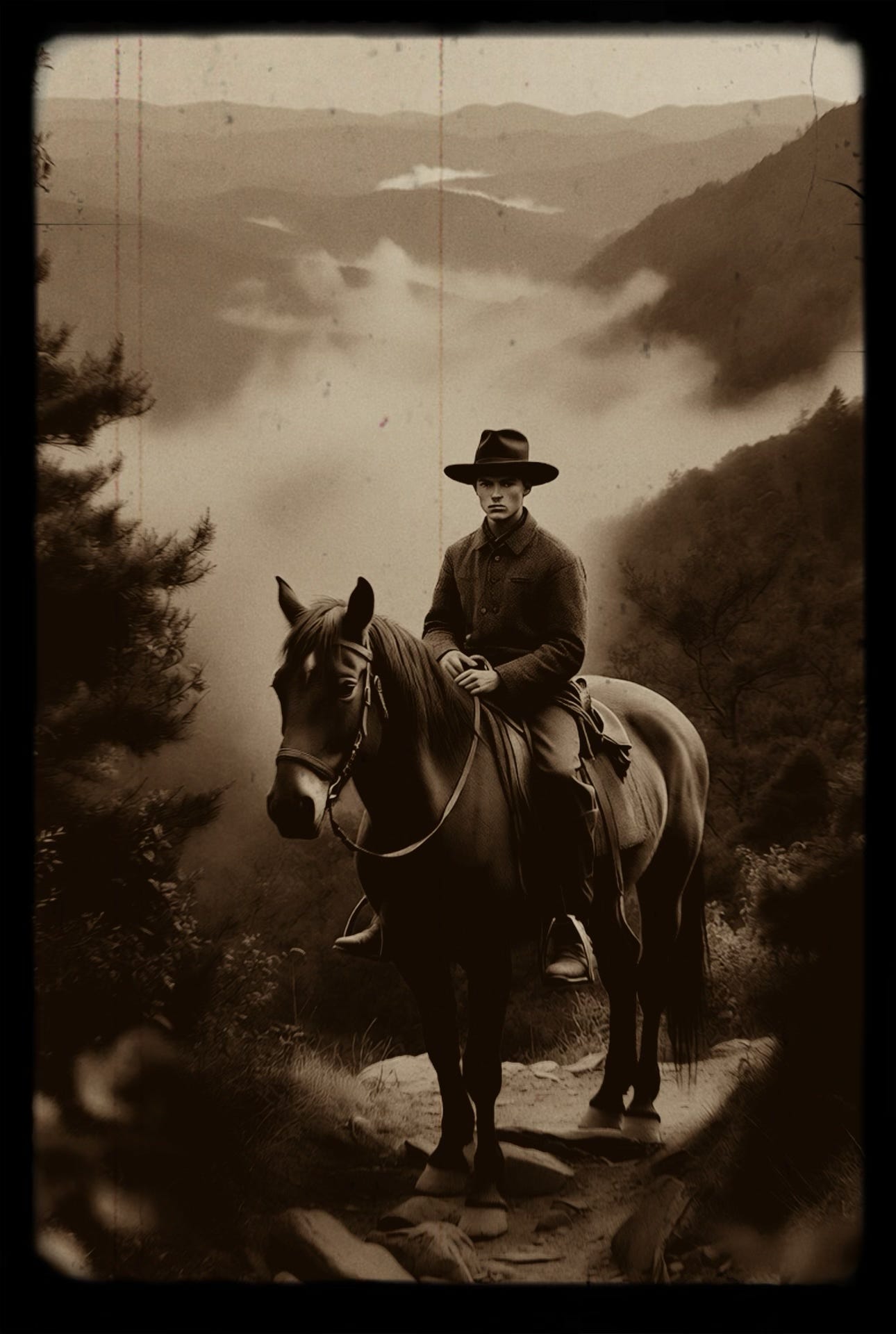
And yeah, he’s young. My age, by the looks of him, but holds himself…I don’t know, like more is expected of him. He’s got a big, dark felt hat on, so his face is in shadow, but his hair is super fair and sticks out below the brim. His long coat, dun-colored, is belted at the waist, and he’s got a rifle across his back, wrapped in oiled cloth. Like real mountain folk.
The rifle’s old time. A Daniel Booney, my granny would call it. Long and slim, with a stock that goes on.
The horse shifts, and its breath plumes, but the rider doesn’t move.
He’s staring at me like I’m a ghost and I guess I’m staring at him like he’s some weirdo.
“Hey,” I say. The word comes out hoarse. “I, uh—”
He says something. Three syllables. Definitely not English.
“I’m sorry,” I say, “I don’t under—”
He says it again. Slowly picking the words like a person picks his way across a creek on stones—“You—are hurt? Lost?”
When he speaks English, there’s something about his voice that’s familiar.
“I don’t know,” I say. “I don’t really know much of anything right now.”
He looks at me a long moment—taking in my clothes, and especially my sneakers.
“They're just cheapies from Walmart,” I tell him. I’m not sure why.
He tips up his face a bit and his cheeks are all wind-burned. That I can see.
He gets down off the horse, doing it in careful motions, keeping the horse between himself and me, like I’m a rabbit he’s trying to keep from sprinting away. When he comes around the animal’s shoulder he holds his hands up. They’re bare and red with cold and one of them is bandaged across the knuckles with a strip of dingy linen.
“You are not from here,” he says.
He’s looking at my jeans like I’ve got no business wearing them. At my barn jacket with its corduroy collar.
I want to laugh. The laugh is right there, under my sternum, and I know if I let it out it won’t stop and won’t be a laugh by the end.
“No,” I say. “I’m from Valemont.”
He nods, slow, but it’s like he’s got no idea what Valemont is.
Then he comes closer, and a fleck of light comes down between the leaves. It lands over his eyes and I just about die.
Because I know his face.
“Mr. Craven?”
Mr. Craven takes off his hat and I get a full on look at him. And yeah, it’s definitely him. Only he looks like he took a bath in the fountain of youth, then vowed never to take another bath again.
“How do you know my name?” His voice is gentle and the gentleness is the first gentle thing in this whole long terrible morning.
“Well,” I say. “I’m not sure.” Because I can’t make myself say the truth. That you’re my teacher, only you’re supposed to look older and not have an accent like that. And you never looked like someone who was born riding a horse. And you wore tweed and not leather and boiled wool. And your hands were soft. But your eyes were just as kind and would find me in the hallways sometimes and I had no idea why.
Mr. Craven crosses himself, but not like he’s doing it to guard against evil. Like it’s a blessing.
“I’m scared,” I say. “And I’m cold.” I take a step back from him without meaning to. “And I want my granny. I want my Granny! I want—”
My whole body starts to shake so hard that I can’t even stay standing. My lips quiver like a flame in a draft and I crumble to my knees, but Mr. Craven catches me, holding me close and warm. It’s the first time I’ve been warm since I left my dorm this morning.
“The night here is not kind,” he says. “A medvěd. A bear. He is awake now and hungry in this season. Men who hunt come here, and not all are good.”
“I don’t have anywhere to go.” I choke it out, and feel like I’m going to throw up. Because somehow I know it’s true. I know that Valemont’s not just a few miles away, and my Granny’s house isn’t a hundred miles after that. I don’t know why or how, but I just know.
“You can come with me,” he whispers.
I find myself nodding because what else am I going to do?
“What’s the year,” I say. It just comes out. I didn’t even know it was a question in my mind.
He cocks his head, but his face goes all soft. Like he’s thinking, the poor thing’s lost her mind. And maybe I have.
“It is the year eighteen hundred and the twenty-nine,” he says. “The month is the third. Eighth day. Or the ninth. The snow has been twice this week.”
Out of my throat comes a strangled sound, animal-like. Keening if I let it, but I won’t.
I feel my knees give again and just let Mr. Craven hold me up, hold me tight. I think eighteen-twenty-nine and the thinking doesn’t attach to anything, like the word sasquatch or something. Or the story of an alien abduction.
He puts the back of his bandaged hand near my cheek, the way you check the heat coming off a stove. Somehow it’s the most tender thing anyone’s ever done to me.
“You will not die today,” he says, very quietly. “I will not let it.”
The most absurd promise ever. And the best.
I start to cry hard.
I cry the way I haven’t cried since I was little, in big ugly heaves. He shifts only enough to take off his coat—the dun-colored one, heavy as a quilt—and settles it around my shoulders, careful and skillful at this. Still holding me up the whole time, as if he’s used to caring for people while doing a bunch of other things at once. The coat smells of woodsmoke and horse and never washed sweat. It’s gross, but kind of comforting, too.
“My name is Bastian,” he says, when I’ve got my breath back enough to hear him. “Bastian. Kraven, like you said.” He looks at my sneaks again, and his face takes on a skepticism I used to see on Mr. Craven when one of us said something outrageous in class. Like when Rosanna Kingston said she thought studying Latin was like studying a corpse.
He lowers me back to the ground and plunges his hand into the cold mud, scraping up a palmful. Then he rubs it all over my shoes. “We should bury them when we get to my village,” he says. “You need them now to stay warm.”
“Bury my shoes? Why?”
Mr. Bastian Craven smiles. “My people are good, but they are suspicious. And fearful. There are dark spirits in these woods.”
“I’m not a dark spirit,” I whisper.
“I know.”
“I’m Grace,” I say. It is the first word I have said in this place that feels like mine. “My name’s Grace Goad.”
And I look carefully at him to see if my name is in the least bit familiar. If it’s a memory, or an echo back from a future he hasn’t lived yet.
“Grác,” he says. He cannot quite get the long a. He turns it into something longer and sweeter, with a vowel that bends in the middle.
“Close enough.” I almost laugh again, but I’m glad it doesn’t come out because his face when he tried my name was so serious and precise, like it mattered to him to get it right.
He stands, offering his unbandaged hand, and I look at it for a long time before I take it. It’s rough across the palm in a way no boy’s hand at home has ever been rough. Not even the ones who actually do some work with their hands. It’s field-work rough. Rein-rough.
The horse—Buran, he says, his name is Buran—is patient. Bastian boosts me up first, then swings up behind me. His arm comes around my middle to take the reins like he’s threading a needle.
“It will be dark when we get there,” he says. “We must go slow. The ground is—zrádný —bad in places.”
I nod, not trusting my voice.
As Buran starts to move, Bastian shifts behind me to ease my balance, murmuring something to the horse in his own language that settles his pace. The trees begin to slide by.
“You are safe now, Gráca,” he says.
But I am wearing a stranger’s coat that smells awful and good all at once, and the sun, what there is of it, is finding the high branches and lighting them up gold, and somewhere in the long terrible day in front of me, my Granny’s voice is saying child, you are not following the wrong light. You are not following any light at all. You are following a boy on a horse, and that is a different thing entirely.
I let my head tip back, just a little, against his shoulder, and he holds strong and firm.
We ride.